
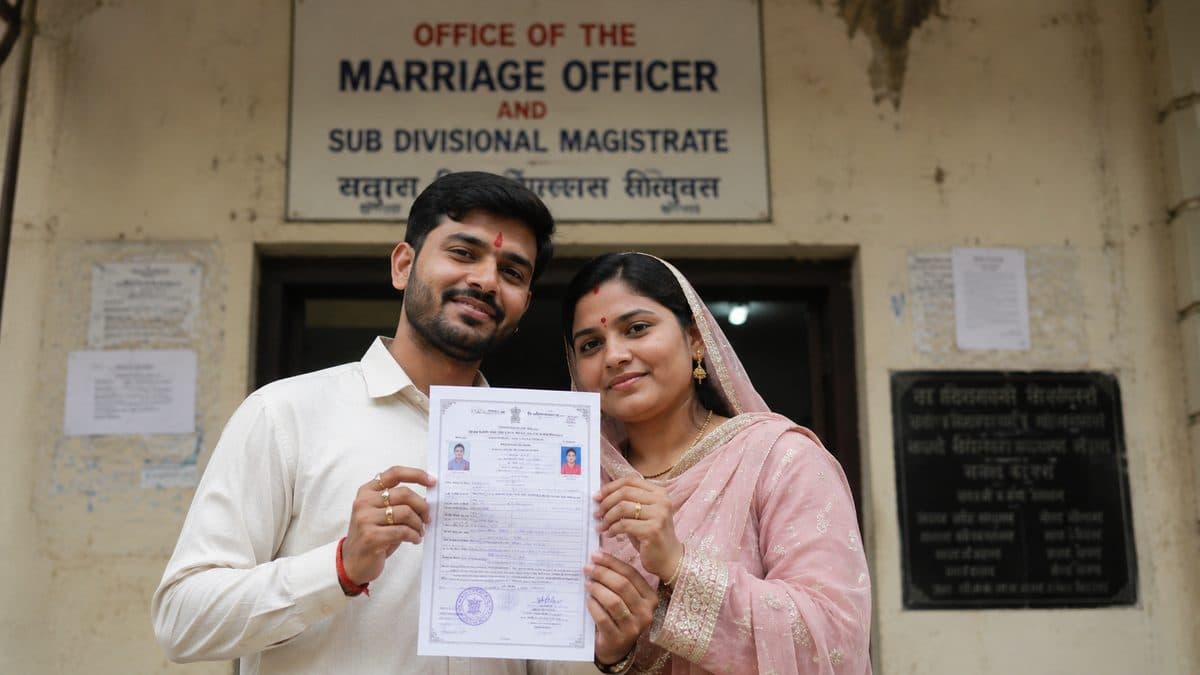
There are two different things people call court marriage. A marriage solemnised under the Special Marriage Act, 1954 requires a written notice to the Marriage Officer, a 30-day public notice period, and then solemnisation before three witnesses — roughly five to six weeks end to end. Registering a marriage that has already been performed by religious ceremony is a separate, much quicker process under the applicable marriage act or state rules.
The confusion costs couples weeks. Inter-faith couples and those marrying without ceremony need the Special Marriage Act route with its notice period; couples already married by ceremony usually just need registration, and are sometimes wrongly told to wait 30 days.
The two routes
| Special Marriage Act | Registration of existing marriage | |
|---|---|---|
| For whom | Any two persons, including inter-faith | Couples already married by ceremony |
| Notice period | 30 days, publicly displayed | Not applicable |
| Witnesses | Three | Typically two to three |
| Timeline | ~5–6 weeks | Days to a few weeks |
| Outcome | Marriage solemnised and certified | Certificate recording the marriage |
Documents usually required
- Proof of age for both parties — birth certificate, school leaving certificate or passport
- Address proof for both parties
- Passport-size photographs
- Three witnesses with photo identity and address proof
- Wedding invitation and ceremony photographs (for registration of an existing marriage)
- Divorce decree or death certificate, where a previous marriage has ended
- Affidavits as prescribed by the Marriage Officer
What if someone objects?
During the 30-day period, any person may object on the ground that the marriage would contravene a condition of the Act — age, subsisting marriage, prohibited relationship, capacity to consent. The Marriage Officer inquires; a frivolous objection does not stop a lawful marriage, and there is an appeal if the officer wrongly refuses. Family disapproval, by itself, is not a legal objection.
The bottom line
Decide which route applies before you queue at any office, assemble the age and address proofs early, and line up three witnesses who can actually attend. Done in the right order, this is one of the few legal processes in India that runs to schedule.