
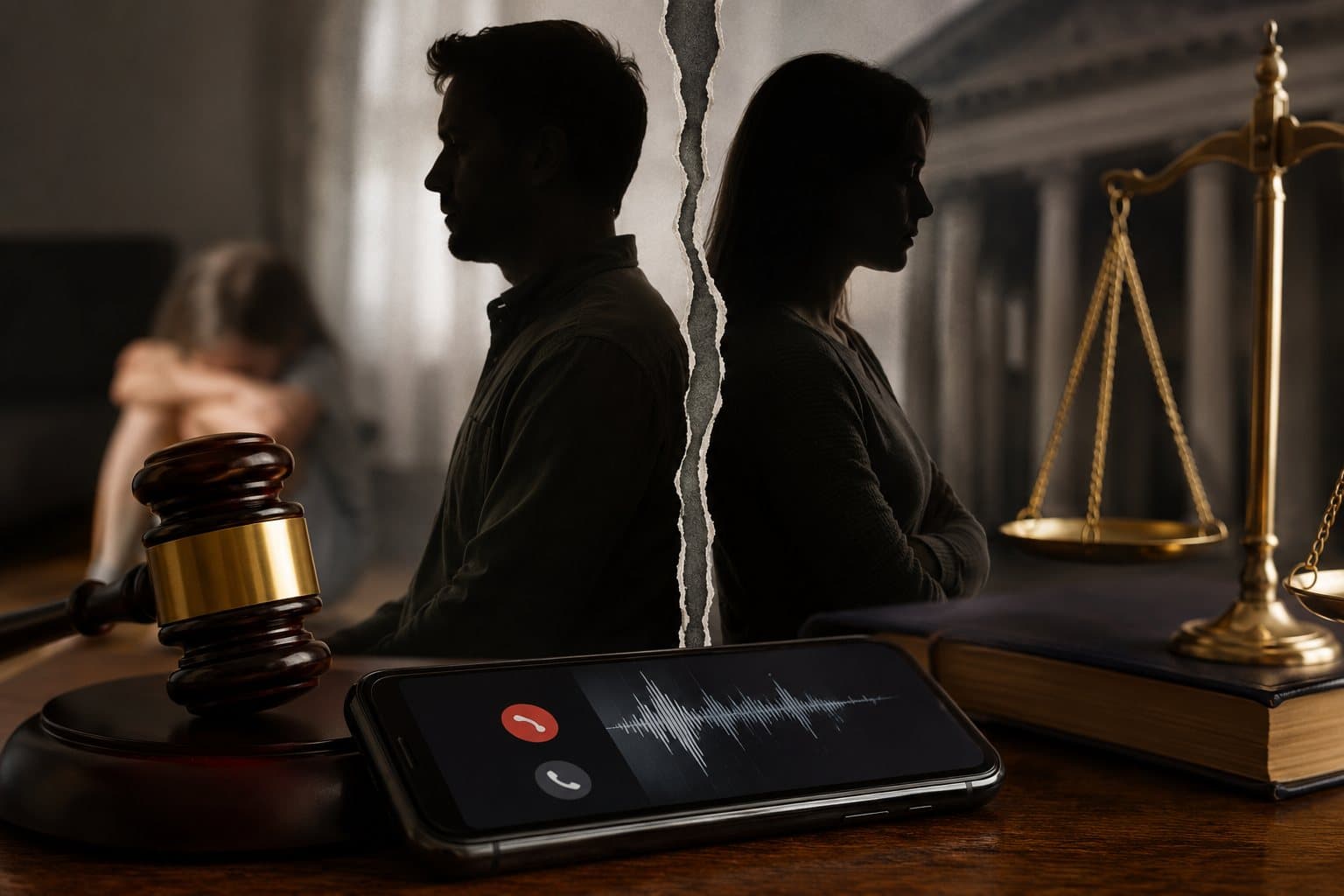
Yes. In Vibhor Garg v. Neha, decided on 14 July 2025, the Supreme Court held that a telephone conversation between spouses, recorded by one of them without the other's knowledge, is admissible in matrimonial proceedings. The privilege protecting communications made during marriage carries its own exception for litigation between the spouses themselves. Admissible, however, is not the same as useful — authenticity, completeness and the certificate under Section 63 of the Bharatiya Sakshya Adhiniyam decide whether the recording survives cross-examination.
The question had been genuinely unsettled. High Courts had gone both ways for years, so the answer a client received depended largely on which judgment their advocate had read most recently. In the case that resolved it, a Family Court at Bathinda allowed a husband to produce memory cards and transcripts of calls with his wife in support of an allegation of cruelty; the Punjab and Haryana High Court set that aside as a breach of her privacy; the Supreme Court restored the Family Court's view.
The reasoning, in plain terms
Spousal privilege — Section 122 of the old Evidence Act, now Section 128 of the Bharatiya Sakshya Adhiniyam — stops a husband or wife from being compelled to disclose what the other said during the marriage, and stops them disclosing it without consent. But the section carries an express exception: it does not apply to suits between the married persons themselves. Once the marriage is the subject of the litigation, the shield that protects marital confidences from the outside world no longer stands between the two parties inside it.
On privacy, the Court took the familiar position that the right is not absolute and has to be weighed against the right to a fair trial. It also noted what Family Courts have always had — a statutory discretion under Section 14 of the Family Courts Act to receive material that would not necessarily be admissible under the ordinary rules of evidence.
What still decides whether the recording helps you
This is where most litigants lose. A recording gets on the record and then does nothing, because the other side asks three questions and no good answer comes back.
| The question in cross-examination | What defeats it | What sinks the recording |
|---|---|---|
| Is this the original, and where has it been? | The device or original file produced, with an unbroken account of custody | A forwarded file, re-recorded from a speaker, or "it was on my old phone" |
| Has it been edited? | The complete conversation, start to finish, with metadata intact | A clip beginning mid-sentence — the single most damaging thing you can file |
| Is it properly certified? | A certificate under Section 63(4) BSA in the prescribed form, with the device particulars | Filing the transcript alone and hoping nobody asks |
| What does it actually prove? | A recording tied to a specific pleaded incident and date | Hours of general unpleasantness offered as proof of cruelty at large |
What the judgment does not permit
It says that a recording of your own conversation with your spouse is admissible in your matrimonial case. It is not a general licence to gather material about them, and the difference matters because the wrong side of it creates fresh liability of its own.
- Installing tracking or monitoring software on a spouse's phone is a separate question entirely, and not one the judgment answers in your favour.
- Accessing their email, cloud storage or bank account without authority can attract liability under the Information Technology Act independently of the divorce.
- Recording conversations you are not a party to — between your spouse and a third person — does not sit within this reasoning at all.
- Sharing recordings with relatives, in groups, or online is a serious and separate risk, and courts take a dim view of it.
The practical effect on how matrimonial cases now run
In practice this cuts both ways, and clients rarely think about the second edge. If your spouse's recordings of you are admissible, so are yours of them — including the conversations you would rather the court did not hear. Anyone contemplating filing recorded material should assume the other side has some too.
The other effect is on preparation. Electronic material now needs to be identified, preserved and certified at the start of a matter rather than produced halfway through evidence. Deleting messages once a dispute is live is worse than useless: deletion is often recoverable, and the attempt is itself the sort of conduct that gets remarked on in a judgment.
If you already have recordings
- Stop using the device for anything that risks overwriting the file. Do not "clean up" the phone.
- Keep the original file and the original device. Copies are for working with; originals are what prove the copy.
- Never trim, join or re-export the audio, however tempting the long silences make it.
- Prepare a transcript separately, with dates, and let the recording stand on its own.
- Tell your advocate what is in all of it — including the parts that do not help you. Surprises in cross-examination are far more expensive than bad facts disclosed early.
The bottom line
The law on admissibility is settled and it is in favour of producing the recording. Whether producing it is wise in your matter is a different judgment altogether, and it turns on what the recording actually shows, what the other side is holding, and whether it is tied to something you have specifically pleaded. Get that read before you file, not after.